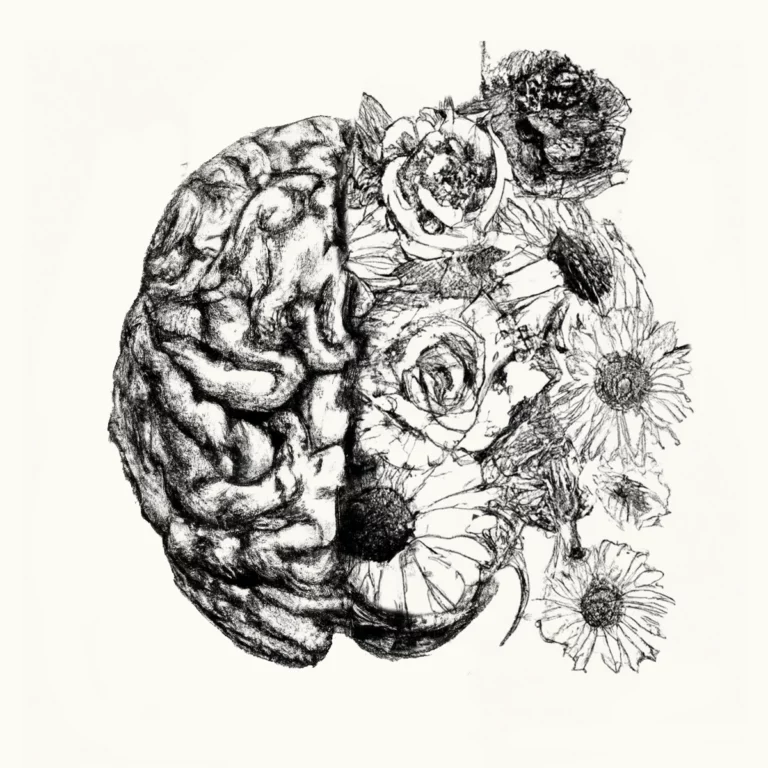

After running a DBR training recently, I found myself struck by the sense of gratitude I have for being able to support such learning, to be able to experience what is one of my most favorite things about being an educator, to witness therapists’ learning, to see them inspired, curious, and hopeful. There is a rich learning experience for students when they experience the “feel” of processing at the subcortical level, and can be with the healing flow that DBR offers. They can learn from the inside of the experience. And, in a world that can often favor a more cortically dominated learning, the bottom-up, experiential component is critical. That said, juxtaposed alongside that need, learning DBR is still, and necessarily so, also highly dependent on a top-down and in-depth understanding of the neuroanatomy. Both are needed. The question often becomes for learners: how does one navigate what can seem almost conflictual in and of itself? I need to learn this, but I don’t understand this, it’s so much material to take in.
And, it is. I get it. I know that this way of learning and being, at the same time, can be deeply challenging.
For me as a learner of DBR, which will be a constant, for we are all learning, is the awareness that just as DBR is rooted in animal models, my learning from animals is also the foundation for the “being with” that DBR requires. It is also the foundation for how I navigate speaking to the process of learning, in and of itself, i.e., learning DBR, both from the top down, and also from the bottom up.
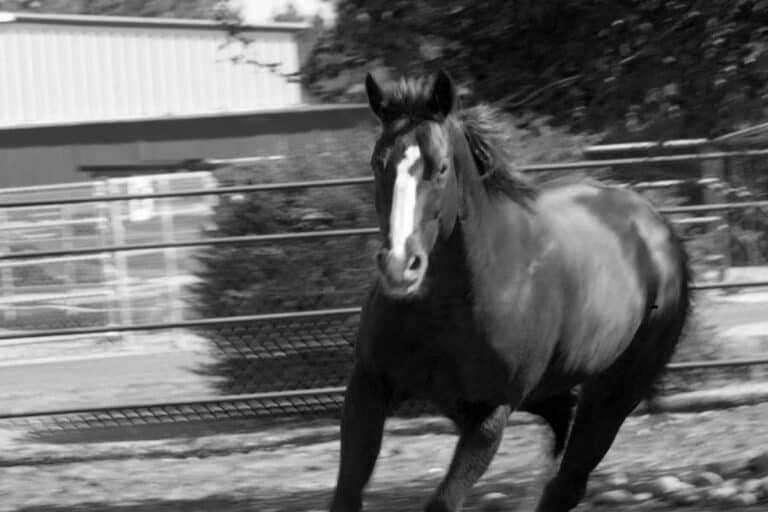
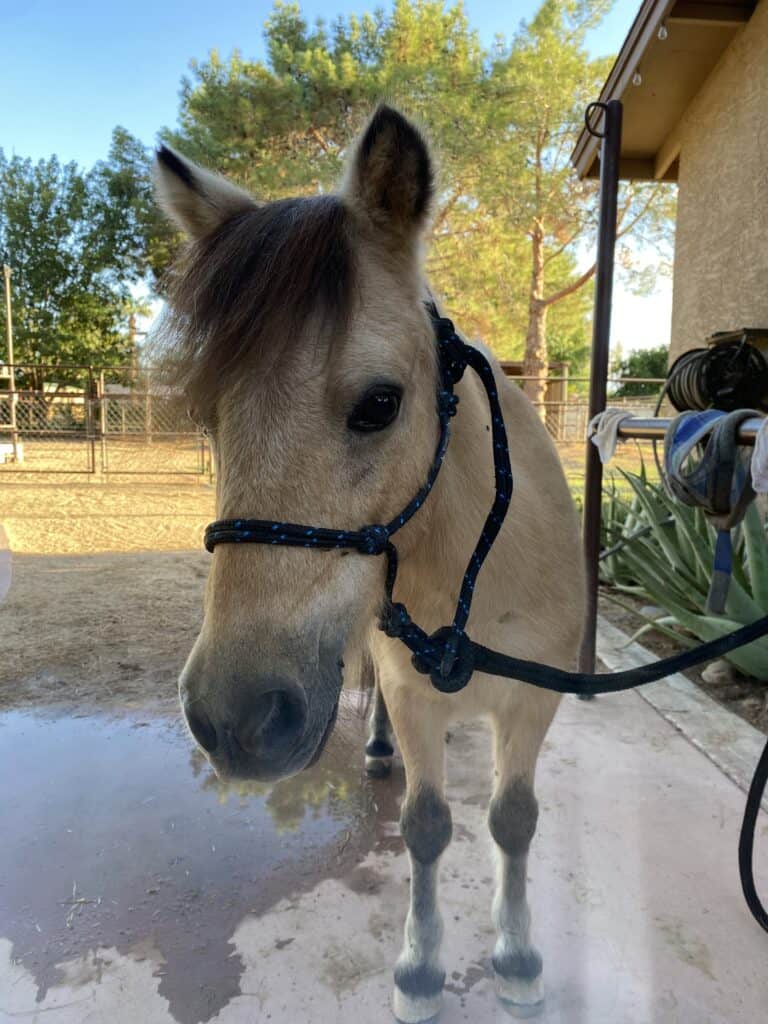
As a lifelong student of the horse, and of the dog, there had been a long time, dare I say it, years, when I was trying to “figure out” a challenge my beloved red mare and I were having with trailering. We could “get it done and trailer” for sure, but it was not the way I wanted it to feel, and it never felt as soft as I knew it could be. It also wasn’t feeling good to her. Adding to it, I had gone to so many trainers, had so much feedback, and learned so many “things to do.” I had an extensive collection of data. Things to do, and I did them, over and over. I was swimming in so much advice on what to “do” that it eventually led me to my own state of shut down, as it did my mare, a co-activation of defensive responses.
But let’s rewind. What in the world could trailering a horse have anything to do with being a student of DBR, to the experience, for many therapists, of learning this emerging and inspiring modality?
To those who may not have horses, it may seem, conceptually, such a simple thing i.e. move horse from location A, put horse into the horse trailer, location B. Drive off. But, here’s the rub, for many of us who consider the horse to be one of our greatest teachers, this can be a space where the human’s intention for the horse to “get in the trailer,” as in many things, becomes an us vs. them, as opposed to a collaborative experience.
For horses, as in all things, it’s about safety, period. Really, everything is. It’s a subcortical need, a primary, foundational need. That’s the constant thing. Nothing else can be addressed without that sense of safety. Meanwhile, for the human at the other end of the rope, focused on “getting the horse in the trailer,” it can, as it was for me for so long, become a cortical experience. For me, specifically, no amount of new “data” could help me be any more effective. I had learned so much, and yet learned nothing, because she and I were still in a pattern where she would just “stall out.” She would have two feet in the trailer and two feet out.
We were at an impasse, and both shut down.
But, the piece that I was missing, was that I had lost my feel for the conversation with my horse. I had stopped listening to what she was showing me, giving me, offering me, asking me. Each ear flick she offered, each step she took, or didn’t take, every slight turn of her head this way or that, that subtle movement of how she weighted one foot more or less than the others, each holding of her breath, or even long exhale, I had just missed in service to my “goal” of “getting her in the trailer.” In fact, I had missed when these things occurred even in the pasture, even before we even got to the trailer in the first place, at the beginning of our sequence, when I haltered her.
Instead, in my attempt to “solve it” I had become cortically dominant and cortically biased, thinking that I needed to “do” something more, as opposed to just “noticing” and then responding to the conversation she was trying to have with me, and what she offered me.
It’s the same thing with my puppy, as we take our two times daily mindful walks. The turn of his head, him looking up at me, the questions he asks, the stimuli on the walk that draw his attention, that he is “checking in” with me regarding. “Can I chase that bird?” “That smell, I’m drawn there.” His way of being in his sense of dogginess, routed in his pack mentality, his more predator nature as a canine, and the sense of how it is critical for his way of being in the world, as he interacts with me.
Fast forward, and now that I have found the conversation with my mare again, and through the subtilties, she and I can access the skills and tools that we both have. I’m still partnering with her to build a newer learning pathway for her, and me, instead of a fast road to the habitual pattern of “stuckness.” The option for that old behavior will still be there, but now, what is the foundation, is my presence with what she was saying without words, so that we don’t reactivate that behavior that I inadvertently “taught” her to execute, a basal ganglia habitual pattern of two legs in, two legs out. Instead, I must be with her in a bottom-up way. I must draw from my understanding of where we are in her brain, as we relate together, so I can also intuit how, when, and even if to intervene. It’s a dance. It’s a feel.
This, too, is the dance of DBR. DBR also asks us to have a conversation, albeit not one that is cortically dominant, but is rather based on feel. Can we nuance the conversation that the client’s sequence is expressing, to be with that, and be mindful of what we have learned both from our bottom up and top-down experiences. Both matter.
I’m also not ashamed to say that much of my personal therapy work has had to focus on my initially being drawn to the therapy world as a distraction from my own pain. Help others, thanks, that’s okay, I don’t need the help. But as the healing flow and sequencing of my own DBR processing has unfolded, that layer of distraction sloughs off, and underneath is a mycelium like layer of nutrient rich aliveness, that tells me the being present and “being with” as we must be in DBR, just as we must be in our four legged, relationships, let alone our two legged ones, is the more comfortable space to be in. Period.
I couldn’t learn what my mare needed to help her feel more comfortable about the trailer, until I recognized that the foundation was my needing to pick up on the nuances of what she was expressing to me, again, without my cortical dominance. Likewise, in DBR processing, the foundation is presencing with the client, and with ourselves without a cortical dominance.
As a learner, in many things, but especially in working with horses, and relating it to DBR, I have had to get out of my own way. I had to be willing to really be with, to listen to the unspoken, and to trust that the skills I have learned, both the top-down and the bottom-up, will be available to me when I need them. Equally so, for all learners, in all things, I believe we must give ourselves the grace to recognize that learning is also a process, not an end goal, when we are learning anything, let alone an emerging therapeutic modality. And, perhaps, just perhaps, we can be open to looking to our four-legged teachers as a way to explore our way of being with our fellow humans, as we do.